Heart rate from your Wear OS watch
Relay broadcasts it over Bluetooth, the same way a chest strap does, so anything that reads a strap can use it.

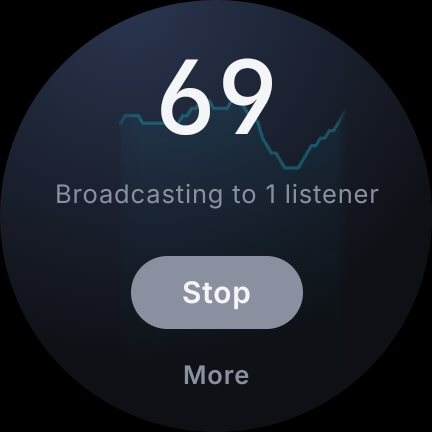
Relay broadcasts it over Bluetooth, the same way a chest strap does, so anything that reads a strap can use it.
Relay makes a Wear OS watch behave like a heart rate strap. It reads the wrist sensor and broadcasts the reading over Bluetooth as a standard heart rate service, which is the same thing a chest strap sends.
That means training apps, gym equipment and bike computers can read your watch the way they would read a strap. Nothing needs to know what Relay is.
It is a standalone watch app. There is no phone app to install, no account, and no sign-in.
Tested on Samsung Galaxy watches. Other Wear OS watches should work too, but have not been confirmed yet.
Relay keeps running once the screen sleeps, so putting your arm down mid-set does not stop the broadcast. You will see it on your watch face the whole time it is going.
Relay cannot give you HRV, and no wrist-worn app can.
An RR interval is the gap between two heartbeats in milliseconds. Heart rate variability is calculated from how those gaps differ from one beat to the next, and it cannot be recovered from a beats-per-minute figure, because averaging to bpm is exactly what destroys it.
The reason is the sensor. A chest strap reads the heart's electrical activity and sees each beat sharply, where an optical wrist sensor infers beats from blood flow through skin, blurring each one by tens of milliseconds. That is the same order of magnitude as the variation HRV is trying to measure, so the thing being looked for is lost in the noise of looking.
This is true of every optical wrist sensor, including the watch's own first-party apps. It is a fact about the hardware rather than a limitation of Relay. If HRV matters to you, a chest strap is still the tool for it.
While you are looking at the watch, Relay sends a reading every second, the same as a strap. Once the screen sleeps the watch delivers sensor readings in batches, five seconds apart, so a receiving app can be showing a value up to five seconds old.
For a set, an interval or a steady effort, that is not something you will notice. For anything where you are watching a number move second by second, a strap will feel sharper. Five seconds is as often as the watch will deliver them while it sleeps, rather than a setting left untuned.
Reading the sensor continuously and broadcasting continuously both use power. In testing, Relay used about as much battery as tracking a workout with heart rate in any other app.
Stop Relay once you have finished, the same as you would end a workout. From version 1.1, if you forget, it stops itself after 15 minutes with nothing connected to it. You can turn that off in Options.
Nearly always the same symptom: the receiving app connects to the watch and then shows nothing at all. There are four causes, and none of them means anything is broken.
What to try first, because it fixes the most common one: switch Bluetooth off and back on on the watch, then start Relay again.
The watch's Bluetooth system keeps one list of services for the whole device, and a registration from an app that has since stopped can be left behind in it. It no longer works, but it is still listed, so a receiving app that finds it first connects to it and waits forever for a reading that will never come.
Restarting Bluetooth on the watch clears that list. Relay cannot do it for you: switching Bluetooth off and on has not been something an ordinary app is allowed to do since Android 13.
Two apps can both offer the standard heart rate service, and a receiving app takes whichever it finds first, which may not be the one actually broadcasting. Run one at a time.
A watch changes its Bluetooth address from time to time, deliberately, so that it cannot be tracked by strangers. An app that saved the old address will keep trying to reconnect to something that no longer exists.
Tell that app to forget the watch and pair with it again, rather than waiting for it to reconnect on its own.
A watch can track one exercise session at a time, so a workout already running in another app stops Relay starting. Relay says so on screen when it happens, and names the activity where the watch tells it. End the other workout and try again.
Different symptom, different cause: the reading was arriving and then simply stopped, and Relay is no longer running on the watch.
The usual reason is power saving. When a watch switches into power saving, either because you turned it on or because the battery got low, it closes apps that are doing expensive work in order to make the remaining charge last. Reading the heart rate sensor continuously and broadcasting continuously is exactly that kind of work, so Relay is among the first to go.
This is the watch doing what it was asked, not Relay failing. Every app on the watch is treated the same way, and an app cannot opt out of it. There is no warning, because the system does not give one.
Worth knowing before a long session: turning power saving on to make the watch last will stop the broadcast. If you want a reading for the whole of something long, start with enough charge rather than saving it partway through.
Other apps on the watch can close it too. A backup program is the one seen so far: Samsung's Smart Switch, backing up the watch, closes each app in turn to copy it, Relay included. It can start a few minutes after an app on the watch is installed or updated, so it is worth checking for app updates before a session rather than during one. Other watches have their own equivalents.
You will know it has happened because Relay disappears from the watch face. From version 1.1, opening Relay afterwards says Broadcast interrupted. Relay cannot tell which of these closed it, because whatever did it gives no warning and takes the app with it. Start it again and it picks up from there, though the gap is a gap.
Relay is written in English first, so other languages may not always read naturally. If something looks wrong in yours, email relay@valt.fitness.
Relay has no account, stores nothing about you, and cannot reach the internet. Your heart rate goes to the device you paired with and nowhere else. The full policy is on the privacy page.
Relay is part of the Valt family but a separate app, and it does not need Valt to be useful. Valt itself is a training log for people who programme their own training, and is coming soon. More about Valt.